
01 · What couverture means
One ingredient decides everything.
Chocolate is cocoa solids suspended in fat. The only question that matters is which fat.
Couverture uses cocoa butter — the fat that comes out of the cocoa bean itself — and nothing else. To be sold as couverture it has to carry a high proportion of it. Cocoa butter is expensive, difficult to work with and has to be tempered by hand. It is also the only fat that behaves the way chocolate is supposed to behave.
Compound replaces that cocoa butter with palm or other vegetable fat. It costs a fraction as much, needs no tempering, tolerates heat, and survives a Pakistani summer on a shelf without complaint. That is why most of what is sold here is compound. It is a perfectly rational commercial decision. It just isn’t chocolate in the sense anyone means it.

02 · Why you can feel the difference
Cocoa butter melts just below the temperature of your mouth.
That single fact is the whole of it. Cocoa butter melts at roughly 34°C. Your body runs at about 37°C. So real chocolate is solid in your hand and liquid on your tongue, and it releases its flavour all at once as it goes.
Vegetable fat melts higher than that. Compound chocolate never fully gives way in your mouth — it softens, coats, and leaves a film behind. That waxy feeling people describe is not a matter of taste or quality. It is a melting point.
Where each fat melts
It is also why we won’t pretend our chocolate survives being left in a car. Ours melts. That is the point of it.
03 · Side by side
What you are actually choosing between.
| Quality | Couverture — what we use | Compound — most of the market |
|---|---|---|
| The fat | Cocoa butter only, from the bean | Palm or other vegetable fat |
| In your mouth | Melts fully and quickly, releases flavour, leaves nothing behind | Softens rather than melts, coats the palate, waxy finish |
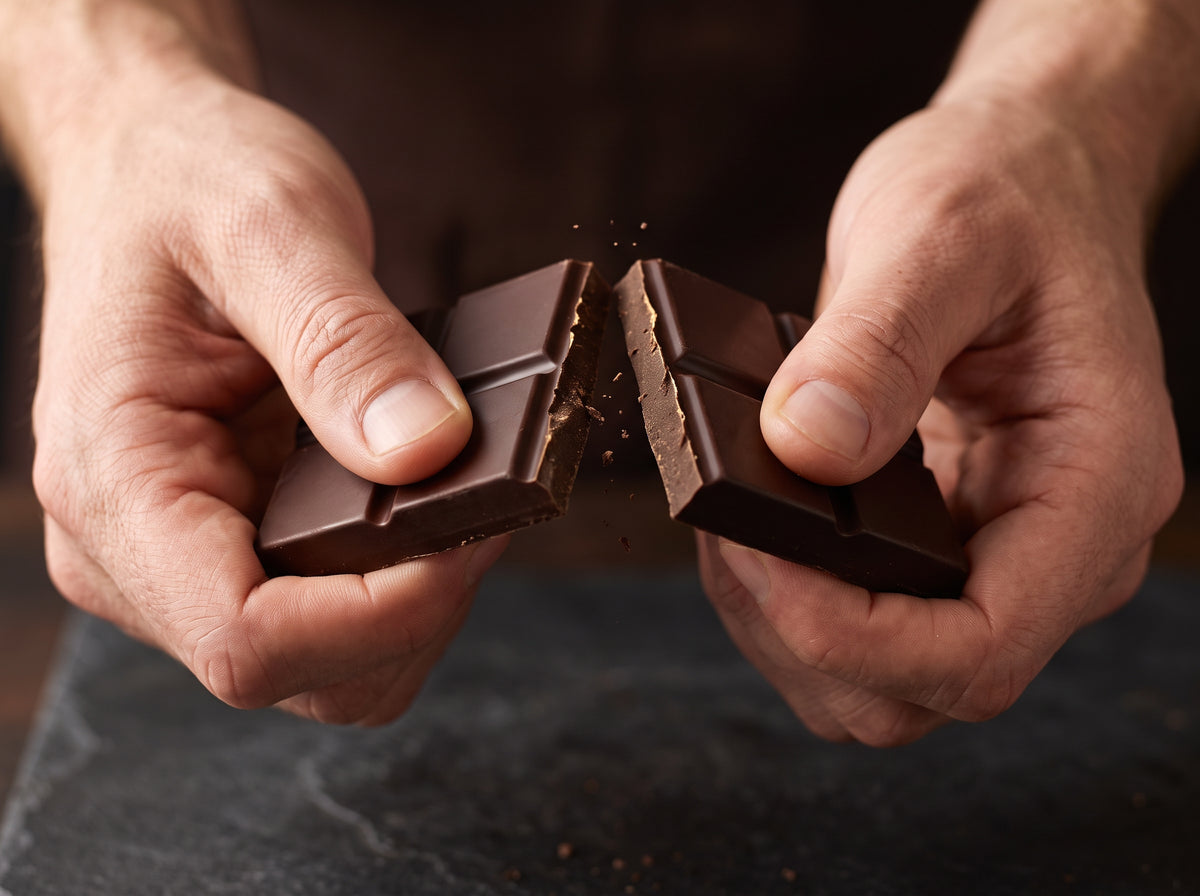
| The snap | Breaks cleanly with a sharp sound — only tempered cocoa butter does this | Bends, crumbles or breaks dull |
| The surface | Mirror gloss straight from the mould | Flat or faintly greasy sheen |
| Making it | Must be tempered — brought through precise temperatures by hand, or it sets grey and soft | Melt and pour. No skill required. |
| In the heat | Melts. Needs cool storage and insulated delivery. | Holds its shape at temperatures real chocolate cannot |
| Cost to us | Several times higher per kilo | A fraction of the price |
04 · Why Belgian
A country that made adulteration illegal in 1894.
Belgium passed a law in 1894 setting a minimum of 35% pure cocoa, specifically to stop manufacturers padding chocolate with cheaper fats. Everyone else arrived at that standard much later, and some markets still haven’t.
What grew out of that is a tradition of grinding finer and conching longer than the rest of the industry — the stage where chocolate is worked for hours until the grit is gone and the texture turns to silk. It is slow, it costs money, and it is the reason Belgian couverture tastes the way it does.
We buy ours from COUVERTURE HOUSE — Callebaut or Belcolade, at 40% for the milk and 20.8% for the dark.

05 · What we can honestly call it
Belgian couverture, made into chocolate in Lahore.
You will see “Belgian chocolate” on a great many products in this market. Strictly, it is a term the Belgian industry reserves for chocolate whose mixing, refining and conching all happen in Belgium. Ours doesn’t — we buy Belgian couverture and make the chocolate here. So we don’t use the phrase.
How we phrase it, everywhere
“Made with Belgian couverture” · “Belgian couverture, tempered in Lahore” · “Belgian recipe”, “Belgian tradition”
What we never say
“Belgian chocolate” · “Imported from Belgium” · “Made in Belgium”
If a brand can’t tell you where its chocolate was made and what fat is in it, that silence is the answer.